


Follow Dalot?!
Relax. This isn’t what you think ✋.
This idea popped into my head after hearing the rather annoying update that Lisandro Martínez could miss Sunday’s game against Villa.
Apparently the Butcher still hasn’t fully recovered from his calf issue. The good news is that it’s not supposed to be too serious according to Chris Wheeler, then again, that’s exactly what they said about Matthijs de Ligt’s back problem.
That was nearly three months ago. De Ligt hasn’t been seen since the end of November.
So forgive me if I take “not too serious” with a pinch of salt.
If Martínez misses Villa, he will not have played since the draw with West Ham at the start of February. That’s already close to a month out. And with the international break followed by an FA Cup weekend, the calendar suddenly stretches out very quickly.
Miss Bournemouth next week as well and Martínez could easily go two months without playing.
Which got me thinking about something.
United’s defence is quietly very injury prone.
The Pattern
Luke Shaw is the obvious one.
He is probably the most injury-prone player in the squad and has been for years. Oddly enough he has only had a small issue this season, but history tells us that relying on Shaw for long stretches of availability is usually optimistic at best.

Martínez unfortunately falls into a similar category now.
Since the end of the 22/23 season his injury list looks like this:
22/23 – Metatarsal fracture
23/24 – Foot injury
23/24 – Knee injury
23/24 – Calf strain
24/25 – ACL
25/26 – Calf issue
That’s a lot.
And the worrying part is the recurring muscle issue. The other injuries were unfortunate but largely one-off problems. Calf issues coming back again is the sort of thing clubs tend to monitor very carefully.
Then there’s Harry Maguire.
Over the past few seasons he has quietly become quite injury prone himself. Two injuries in 23/24, three more in 24/25, and this season alone he has already missed around 10 games through knocks and thigh problems.
Also worth remembering that he’s 33-years-old.
De Ligt is the strange one.
Before arriving at United he had the odd issue here and there but nothing that screamed “injury risk”. Yet this back problem has turned into the longest layoff of his career and he has already missed more than three months.
There’s still no clear return date either.
Noussair Mazraoui has also struggled.
Three injuries this season, around two months out in total, and even in the defeat to Newcastle he had to come off early because of another small problem. Thankfully that one seems precautionary.
Then we have the younger group.
Leny Yoro arrived with an ankle problem and had another foot issue last season, Ayden Heaven had a similar foot injury previously and Patrick Dorgu has now missed six games this season.
They are young players and injuries at that stage of a career are not unusual, but it does mean you cannot rely on them to carry the defensive structure yet.
That would be too much pressure too soon.
On a side note, I believe that Dorgu has been the biggest miss among injuries this season.
When you put all of that together, a picture starts forming.
This isn’t really about quality. The problem is availability.
And that brings us to Diogo Dalot.
The Dalot Paradox
Dalot is probably the least popular defender in the fan base.
Plenty of supporters think he isn’t good enough and, to be completely honest, his performances for a couple of years have not exactly been inspiring.
But there is one thing he has over the rest of the defence: availability.
Now to be fair, Dalot hasn’t had a completely injury-free career. He has had his issues in the past and even picked up a minor one earlier this season.
But compared to everyone else at the back, he is the one player the manager can almost always rely on.
Which is why I say he “sets the standard”.
Not in terms of ability.
In terms of professionalism.
Dalot is extremely close to Cristiano Ronaldo, who famously mentioned him during that explosive interview before leaving the club. For Ronaldo to single you out in that way probably means you are doing something right behind the scenes.
And when you watch Dalot speak or carry himself, the influence is obvious.
Professional. Disciplined. Serious about his body, the kind of habits that allow players to stay available.
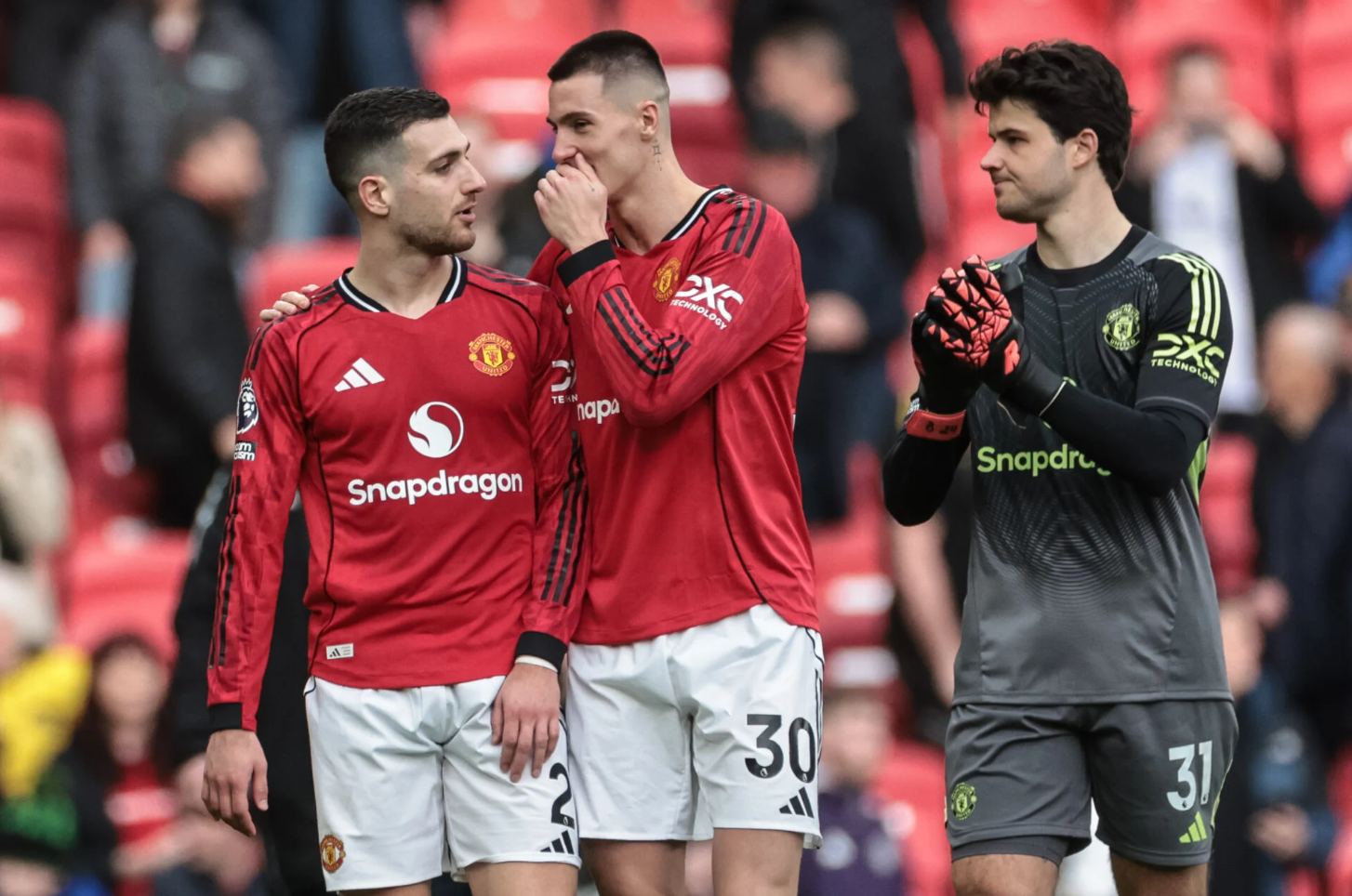
Interestingly, Benjamin Šeško seems to be cut from a similar cloth. The two have become quite close this season, something that was obvious in that recent barbershop video on the club’s socials. Šeško has also received praise for how well he looks after himself.
Maybe that similarity is not a coincidence.
So the strange reality is that the defender many fans want replaced might actually be the example others could learn from.
Funny how football works sometimes, eh?
The Bigger Questions
The annoying part of all this is that the club rarely communicates these injuries clearly.
Players are often said to have “minor issues” and then disappear for weeks or months.
Which raises another possibility.
Do the club actually know how long these injuries will take?
United’s medical department has been questioned for years. Supporters often feel that players return too early, only for the same problem to resurface shortly afterwards.
And the list of injuries this season is not limited to defenders either. Mason Mount, Matheus Cunha, Šeško, even Bruno Fernandes have had their own issues.
All of this despite the fact that United are playing one game a week.
Michael Carrick has reportedly reduced the intensity of training and even gives the squad additional recovery days.
So the question naturally appears: If the workload has been reduced… why are the injuries still piling up?
That also leads to another uncomfortable discussion.
Recruitment.
If certain players already had injury histories, did the club properly assess the risk before signing them?
And if they did, why do some of those problems suddenly seem to worsen once players arrive at United?
The Structural Problem
There is also a squad building angle.
When certain defenders are missing, the team looks very different.
Without Martínez, the defence loses its composure in possession.
Without Mazraoui, the options at full-back become extremely limited.
And when multiple players are missing at once, the entire structure begins to wobble.
Young players like Yoro, Heaven and Dorgu then have to fill those gaps before they are fully ready themselves.
Constantly rotating defenders also changes how the team plays. Different players bring different strengths and weaknesses, which forces adjustments across the entire system.
In a position where stability is normally vital, United rarely seem to have it.
We must have had around five or six different centre-back pairs this season.
The Point
So the idea of “following Dalot” is not really about copying his football ability.
It’s about something much simpler.
Reliability.
For a team with so many defenders, United spend a surprising amount of time without them.
And maybe that is the real issue.
Not quality.
Not tactics.
Just the basic ability of the defence to stay on the pitch.
Right now, the one defender who consistently manages that is the one most supporters seem to rate the least.
Football is strange like that.
What are your thoughts about this? Is Dalot a genuine example for the defence to follow in terms of self-care? Do United need to look into these injuries a lot more? Or do you disagree entirely?
Diogo Dalot | Image credit: Getty Images via Goal